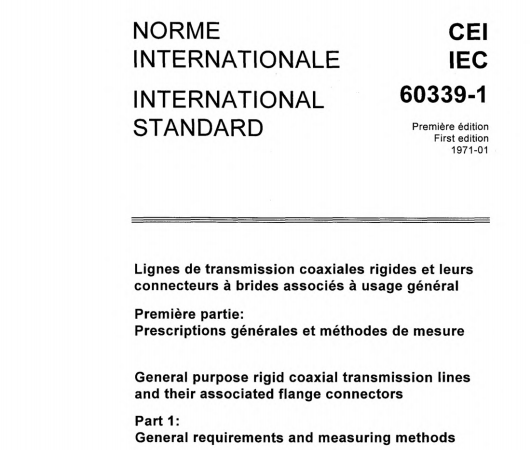
IEC 60339-1:1971 pdf download – General purpose rigid coaxial transmission lines and their associated flange connectors. Part 1: General requirements and measuring methods.
IEC 60339-1:1971 is an international standard published by the International Electrotechnical Commission (IEC) that establishes general requirements and measuring methods for general purpose rigid coaxial transmission lines and their associated flange connectors. Prepared by Sub-Committee 46A (Coaxial cables) under Technical Committee 46, this first edition was published in January 1971 and remains a valid standard with a stability date extending to 2030.
The primary purpose of this document is to ensure compatibility and interchangeability between rigid coaxial transmission lines and their flange connectors from different manufacturers. To achieve this, the standard specifies the tolerances necessary to guarantee adequate electrical performance and provides the corresponding test methods for verification. By standardizing these requirements, the publication aims to facilitate international harmonization and reliable interconnection in RF and microwave transmission systems.
The document is 23 pages in length and falls under ICS classifications 33.120.30 and 33.120.10, covering coaxial cables and waveguides. It serves as a fundamental reference for manufacturers, engineers, and technicians involved in the design, production, and testing of rigid coaxial transmission line components. The standard addresses both the mechanical and electrical aspects of these components, providing a common basis for evaluating their performance and ensuring that products from different sources can be used together effectively. Its continued validity reflects its enduring relevance in the field of radio-frequency transmission technology.