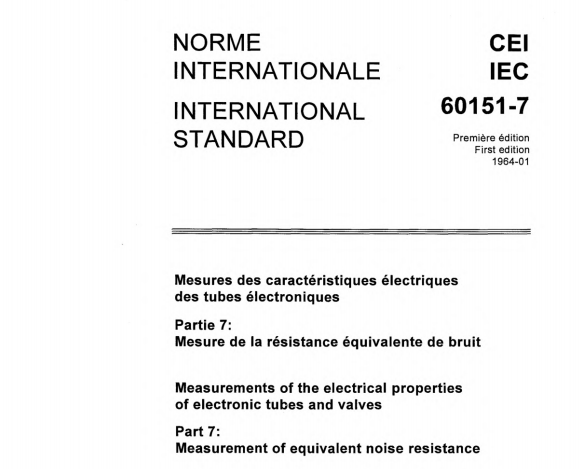
IEC 60151-7:1964 pdf download,Measurements of the electrical properties of electronic tubes and valves. Part 7: Measurement of equivalent noise resistance.
IEC 60151-7:1964 specifies a method for measuring the equivalent noise resistance of electronic tubes and valves. Equivalent noise resistance is a parameter used to express the internal noise generated by a tube as an equivalent resistance producing the same noise effect under defined conditions. It provides a convenient way to compare low-noise performance between different valves and operating points.
The document establishes the measurement principle, test circuit, electrode connections, supply conditions, signal frequency, bandwidth, impedance arrangement, and operating point required for reproducible results. It considers the relationship between the tube’s noise voltage or noise current and the equivalent resistance calculated from the measured noise contribution. The method is intended to distinguish intrinsic tube noise from interference introduced by the heater or filament supply, external resistors, power supplies, wiring, shielding, grounding, and measuring instruments.
Accurate testing requires stable electrode voltages, controlled heater operation, suitable impedance matching, adequate screening, and a measurement system with sufficiently low background noise. The reported result should identify the tube type, electrode configuration, frequency, circuit conditions, bandwidth, applied voltages, current, measuring arrangement, and any corrections or limitations.
IEC 60151-7:1964 supports laboratory characterization, type testing, production inspection, quality control, research, procurement, and circuit design. Overall, it provides a common basis for evaluating and comparing the noise behavior of electronic valves, particularly when selecting devices for sensitive radio-frequency, communication, receiving, and amplification applications.