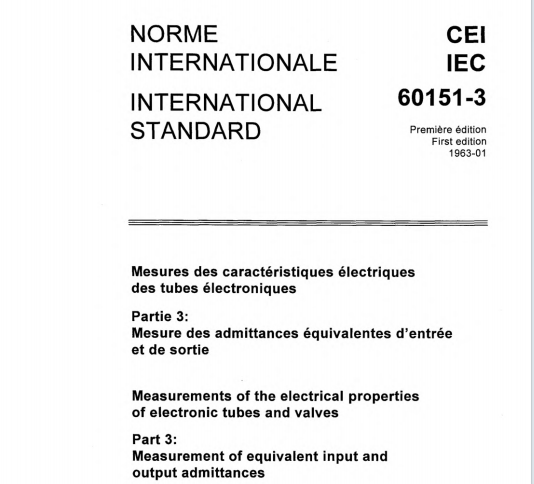
IEC 60151-3:1963 pdf download,Measurements of the electrical properties of electronic tubes and valves – Part 3: Measurement of equivalent input and output admittances.
IEC 60151-3:1963 establishes a standardized basis for measuring the equivalent input and output admittances of electronic tubes and valves. These admittances describe the alternating-current behavior seen at the input and output terminals of a tube under specified operating conditions. They are important for evaluating high-frequency performance, signal transfer, loading, feedback, stability, gain, and circuit interaction.
The document defines the conditions under which the measurements are to be made, including electrode connections, applied direct voltages, operating currents, signal frequency, amplitude, and stabilization of the device. It explains how the tube is connected in the measuring circuit and how the relevant current and voltage relationships are obtained without significantly disturbing the normal operating point.
Equivalent admittance is generally expressed as a complex quantity containing conductance and susceptance, allowing both energy loss and capacitive or inductive behavior to be characterized. The standard therefore supports determination of the real and imaginary components of the input and output admittances, together with appropriate conversion, correction, and reporting procedures.
Attention is given to minimizing errors caused by stray capacitance, wiring, instrument loading, leakage, imperfect shielding, and unstable power supplies. Results should identify the tube type, electrode configuration, operating conditions, frequency, measuring arrangement, and accuracy.
Overall, IEC 60151-3:1963 promotes reproducible admittance measurements for tube design, circuit analysis, manufacturer specifications, type testing, quality control, and comparison of electronic valves used in communication and other high-frequency equipment.